

'Woah!' Christian Nationalist Podcasters Celebrate Eugenics-Based Essay from 1921
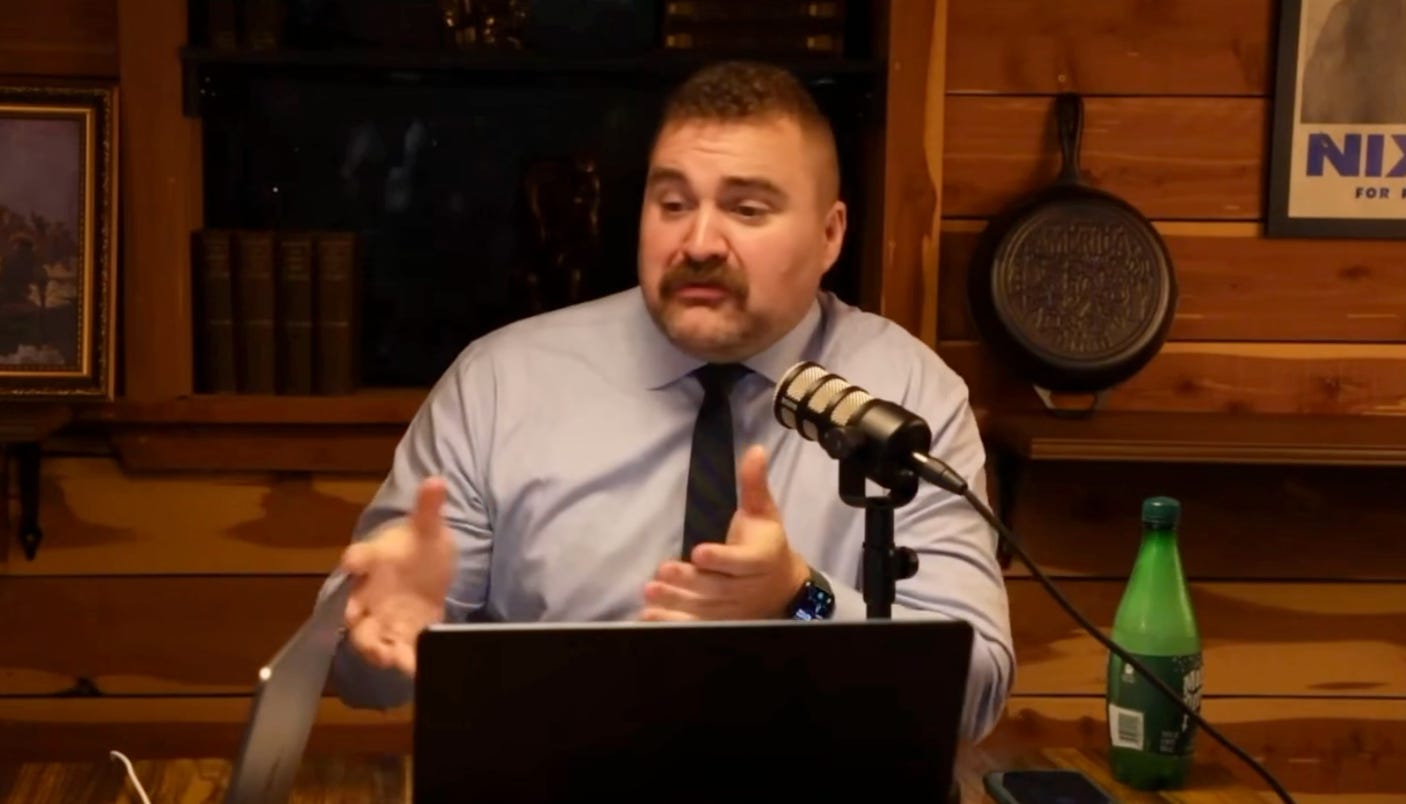
It takes a lot to shock me these days, but these clips with Christian nationalists Andrew Isker and C.Jay Engel talking about race left me gobsmacked.

“Any theory which involves the claim that racial or ethnic groups are inherently superior or inferior, thus implying that some would be entitled to dominate or eliminate others, presumed to be inferior, or which bases value judgments on racial differentiation, has no scientific foundation and is contrary to the moral and ethical principles of humanity.” — UNESCO Declaration on Race and Racial Prejudice, November 1978
For many decades, it has been widely accepted that the “junk science” of eugenics led President Calvin Coolidge to embrace flawed notions that race made some people better suited to be American citizens than others.
“There are racial considerations too grave to be brushed aside for any sentimental reasons,” Coolidge wrote in a 1921 essay in Good Housekeeping as he was about to assume the vice presidency.
“Biological laws tell us that certain divergent people will not mix or blend. The Nordics propagate themselves successfully. With other races, the outcome shows deterioration on both sides. Quality of mind and body suggests that observance of ethnic law is as great a necessity to a nation as immigration law.”
That race-based view of humanity led to the forced sterilization of Americans who were somehow deemed to be unfit and, after being embraced by Adolf Hitler, to the many horrors of the Nazi Holocaust.
But for Christian nationalist podcasters C.Jay Engel and Andrew Isker, both who have now settled in Jackson County, Tennessee, Coolidge’s words provide a refreshing affirmation of their own views of what it means to be an American.
Watch the clips below, and decide for yourself.
‘Whose country is this?’
During a 70-minute episode of the Contra Mundum podcast this week, Isker and Engel read and celebrated Coolidge’s more than century-old essay. Three years later, after Coolidge had become president, the KKK-influenced Congress passed the Immigration Act of 1924, which set race-based preferences for immigration.
That essay was titled “Whose Country Is This?”
“Woah!” Isker proclaimed after his sidekick read the paragraph where Coolidge wrote about “racial considerations too grave to be brushed aside.”
Engel continued, “I think one of the fascinating things is, like, Calvin Coolidge—after he wrote this piece—was elected president.”
“Yeah,” Isker agreed. “There weren’t journalists that took this quote, this paragraph and said, ‘Did you know he said this?’”
“Yeah, this was normal,” Engel interjected.
Isker continued, “The entire country was like, yeah, we want this guy to be our president.”
“This is how they thought. This was normal language,” Engel agreed, calling Coolidge “a deeply Christian man.”
At no point did Isker or Engel ever acknowledge that such “race science” theories from America’s dark past have been widely discredited and rejected.
‘White people from around Great Britain’
Instead, the podcasters appeared to find affirmation of their own beliefs that, consistent with the Immigration Act of 1924, White descendants from western and northern Europe—the Nordics, as Coolidge called them— are the ones with the only real claim to become U.S. citizens.
Engel, ignoring the many immigrants who come to America from all over the globe during its 250 years, argued that the only ones who made the country a “nation of immigrants” are the ones from western and northern Europe.
“It’s immigrants, but restrained to this geographical area,” he continued.
Isker agreed. “This is, like, White people from the area around Great Britain—so, like, northern Germany, France, Britain, Ireland, and then the Scandinavian countries. That’s who he’s talking about as, like, the ethnicities that mixed.”
“And it’s like, well, we don’t want these people from, you know, eastern Europe that are going to come cause problems, that can’t mix very well with us. That’s the distinction that he’s making.”
As I pointed out in a previous post, eugenics helped fuel the notion that immigrants from neighboring countries—Italy, for example—were somehow biologically unfit to become Americans.
Among the group of immigrants deemed to be less desirable at the time were the Italian ancestors of conservative Supreme Court Justice Antonin Scalia.
Does Vivek ‘look’ like an American?
Both Isker and Engel have argued that the U.S. belongs to “Heritage Americans,” by which they primarily mean people from White European backgrounds.
“How do you define Heritage American? How do you define it?” Isker asked.
He suggested that a Japanese person could look at a picture of former GOP presidential candidate Vivek Ramaswamy, a second-generation Indian American, and tell by looking at him that he is not an American.
“They’ll get it right every single time,” Isker added.
“Isn’t that crazy?” Engel replied, seemingly feigning disbelief.
“They’ll know.” Isker continued.
“How do they know that?”
“They know what an American is.”
People with funny names ‘don’t care about this place”
In another tangent, Isker referred to a judge with a foreign-sounding name who ruled against President Donald Trump’s efforts to revoke the Temporary Protective Status granted to immigrants under former President Joe Biden.
Isker gave a name that did not match any of the judges that I could identify as having ruled on such TPS claims.
“This is a person whose background is not consistent with American institutions,” he argued based on the supposed name of the judge. “He has no conception of the world of Alexander Hamilton or even Calvin Coolidge.”
Isker continued, “America exists as a place for him and his people to extract from. That’s all that it is. And our institutions are chocked full of people like this that don’t care about this place, that don’t care about its people. It’s a scam.”
How can he tell based on the person’s name?
NOTE: Isker and Engel responded to this post in a live version of the Contra Mundum podcast.

Please watch the clips, decide for yourself, then tell me what you think.
The confidence in their delusion is what is most terrifying. These are true believers.