In Far Right's Growing 'Remigration' Talk, Echoes of KKK America
Listen closely to what far-right figures are now saying about immigration, and you will find few differences from the xenophobic debates of the 1920s.
In recent years, America’s far right convinced voters they were worried about illegal immigration.
But listen closely to what they are now saying, and you’ll find growing openness about a more ambitious plan to, in effect, Make America White Again.
It’s a plan, as I document below, rooted in a century-old effort led by the Ku Klux Klan to reclaim America for the people they considered to be “real Americans.”
Those so-called real Americans, of course, were the White Americans.
‘Make America look like America again’
Among the clues, President Donald Trump’s Department of Homeland Security calls for deporting 100 million people—a goal almost seven times the estimated number of immigrants illegally in the country.
“America for Americans,” the official DHS account proclaims in other posts on X.
***
Former Customs and Border Patrol official Greg Bovino now admits that, in fact, he had a plan to deport almost a third of the country—a notion that we now see making its way into mainstream GOP politics.
“We have roughly 100 million people in this country who shouldn’t be here,” said Texas Railroad Commissioner candidate Bo French, drawing enthusiastic applause from the crowd at this year’s CPAC.
“They don’t share our values. They don’t want to assimilate.”
South Carolina GOP Senate candidate Paul Dans has also embraced the concept.
***
Tennessee Congressman Andy Ogles, who has boasted about his A+ “remigration score” from a shadowy group I linked to a pro-Nazi account on X, calls for repealing the 1965 Hart-Celler Act.
Prior to that law’s passage, racist “nation-of-origin” preferences established in 1924 had largely limited immigration for four decades to White people from western and northern Europe.
Calling for the deportation of all Muslims, Ogles talks about wanting—pay close attention—to “make America look like America again.”
The diehard MAGA congressman follows a white-supremacist account on X that calls for a plan to “go from 55% White American to 80% White American.”
***
Former Trump administration official William Wolfe, who is leading an effort to try to push the Southern Baptist Convention further to the right, sparks outrage with his unapologetic public pronouncements about race.
“I want my boys to grow up in a country where they don’t look like they’re the foreigners,” Wolfe told a far-right group that calls itself the “True Texas Project.”
His tweet—”total immigration moratorium, 100 million deportations, denaturalization, and remigration”— drew praise from the same white supremacist account that has set a goal of making America 80 percent White.
***
And Tennessee-based Christian nationalist podcaster C.Jay Engel, who has recently created a “White advocacy” group with the help of a man who publishes pro-Nazi materials, voices similar desires.
Declaring that the country belongs to “Heritage Americans,” Engel argues for an immigration system that reflects discredited theories that “genetics are part of the foundation of a people.” He demands a reversal of “the consequences of Hart-Celler” and a “return to the patriotic immigration system” of the 1920s.
As Cato Institute immigration expert David J. Bier recently told me, those proposals reflect far-right dreams of bringing what amounts to ethnic cleansing to America. (You can watch the entire interview below.)
“They’re telling us explicitly what their agenda is, and it is an agenda targeting not just … immigrants here or illegal immigrants even. It’s about targeting Americans based on their background,” Bier told me.
“And that’s ethnic cleansing. That’s the definition of ethnic cleansing.”
Echoes of KKK America
In such talk, you can hear echoes of KKK America, a dark chapter in U.S. history when politicians decided that the “Nordic race” was the superior race.
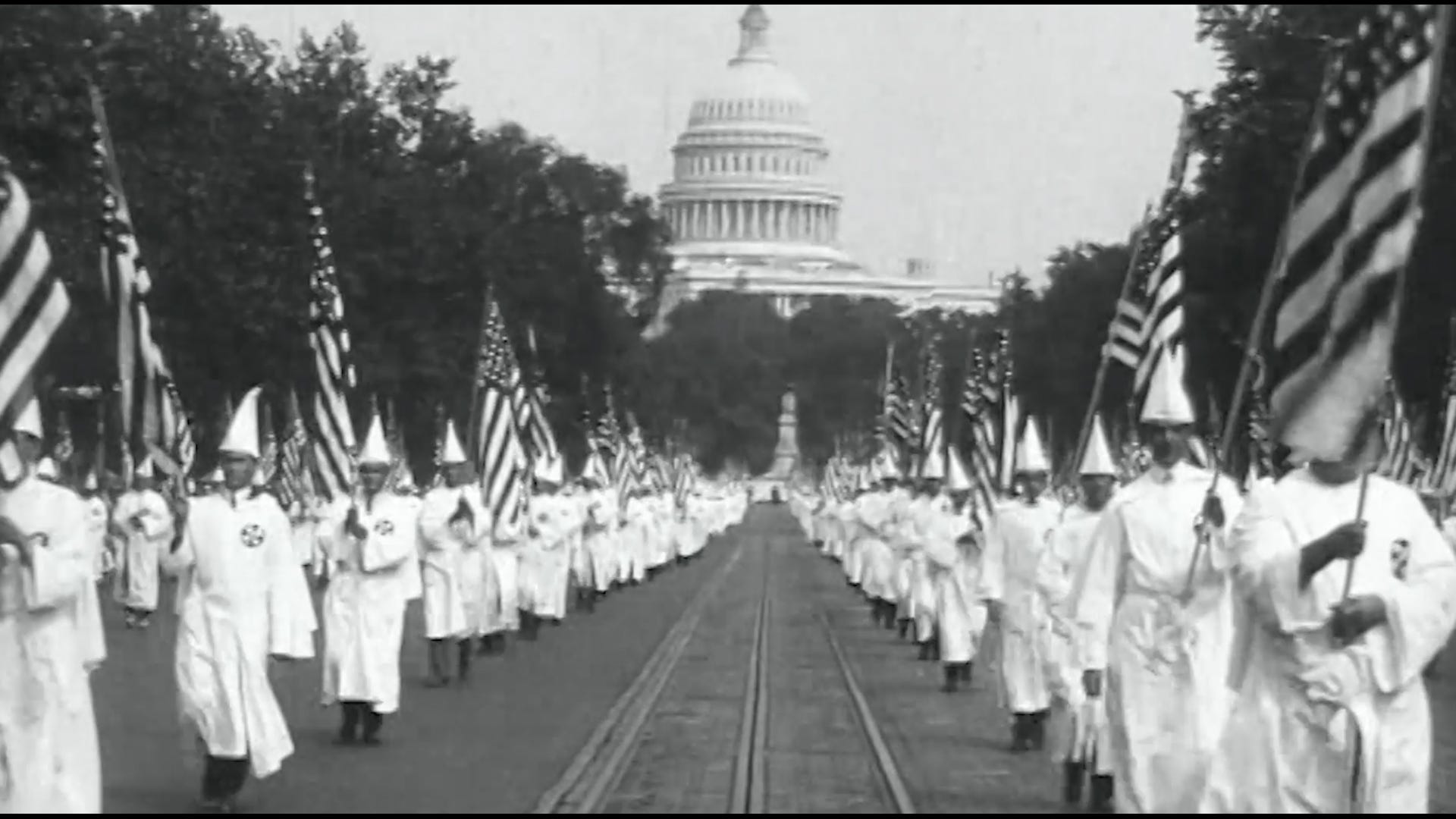
In the 1920s—the decade that brought the “patriotic immigration system” praised by podcaster C.Jay Engel—as many as 60,000 Ku Klux Klan members, in white robes and hoods, paraded down Pennsylvania Avenue in the nation’s capital. An estimated 150,000-200,000 people lined the parade route.
Like today’s far right, Klan members proclaimed themselves “100 Per Cent Americans,” carrying the Stars and Stripes as their marching bands performed the patriotic medleys of the Republic.
By some estimates, millions of Americans—including one out of every seven White men—were registered members of the Klan at the peak of its popularity.
“We hold firmly that America belongs to Americans and should be kept American,” KKK Imperial Wizard Hiram Wesley Evans wrote in 1925.
A year earlier, the influence of the Klan’s publications had been felt on the floor of the U.S. House as lawmakers debated whether to impose strict immigration quotas in an effort to protect the race they viewed as the superior race.
“Mr. Chairman, I know that many of you gentlemen who are going to vote for this bill ... will do so because the word has been given ... by the organization that at present seems to me to be all powerful and who directly through its organs, The Fiery Cross and The Forum, are insistent upon this legislation,” observed Rep. Adolph J. Sabath, a Democrat from Illinois.
Everyone agreed that there was a need for strict controls to deal with the country’s burgeoning immigrant population.
Then, as now, the argument was over the dogged insistence by some that certain immigrants were just not the right fit for America.
The legislation had been shaped with the help of practitioners of the now-discredited “race science” of eugenics. Immigrants from Italy, Spain, Greece, Poland, Russia, and Turkey—to name a few—were deem genetically inferior to people from western and northern Europe.
Ironically, had they not immigrated before the doors slammed shut, the “inferior” Italian ancestors of conservative Supreme Court Justice Antonin Scalia would likely never have made it to America under the “patriotic” system to which some on the far right would like to see the country return.
Rep. Albert Johnson, the Washington state Republican who authored the bill, argued there was a need for legislation that would “end forever the idea that the United States is an asylum for the oppressed of the world.”

Sound familiar?
‘The future of the Nordic race’
Others were more blunt, calling for “Nordic unity”—by which, one critic said, they meant people who were “tall, blond haired, have blue eyes, straight noses.”
“The future of the Nordic race and, thus the human race, depends upon the English-speaking people standing together,” said Rep. John J. McSwain, Democrat of South Carolina, quoting a Columbia University professor.
Rep. Clarence F. Lea, a California Democrat, argued that “true assimilation requires racial compatibility.”
“Nature’s God has given the world a brown man, a yellow man, and a black man,” Lea told his House colleagues. “Whether given to us by the wisdom of a Divine Ruler or by our own prejudices or wisdoms, we have a deep-seated aversion against racial amalgamation or general social equality with these races.”
Rep. Robert E.L. Allen, Democrat of West Virginia, insisted, “The primary reason for the restriction of the alien stream is the necessity for purifying and keeping pure the blood of America.” Allen was appalled that an immigrant would have the right, “whatever his breed to mix his blood with that of our children.”
“America must protect America and American institutions for Americans,” agreed Rep. Jacob L. Milligan, a Democrat from Missouri.
While embracing their own hyphenated Anglo-Saxon identities, the bill’s proponents objected to the existence of “Little ltalys” and “Chinatowns” in America’s largest cities.
“When a woman marries a man, she takes his name and gives up hers,’‘ said Rep. Allard H. Gasque, a South Carolina Democrat. “Those who come to live in our home—America—should take our name.”
Just some now bemoan the influence of Indian Americans in the ownership of hotels or convenience stores, proponents of the legislation wrang their hands over Greek Americans who had invested in restaurants, candy kitchens, fruit stands, and similar establishments.
“Greeks are fast approaching a monopoly on these lines of business,” worried Rep. Addison Smith, Republican from Idaho.
‘No greater curse’ than freed slaves
Perhaps the most blatant reflection of the tenor of the debate came from the racist mouth of Rep. Ralph Waldo Emerson Gilbert, a Kentucky Democrat who was still smarting from the emancipation of America’s slaves.
“No greater curse could ever have been inflicted upon a people than the importation of Negro slaves into this country when their subsequent elevation to equal rights and privileges shall have in fact been consummated,’‘ Gilbert argued.
The Kentucky congressman was aghast that, as he recounted, “The other day one of this race with thick lips, curly hair, was entered into a beauty contest with White girls in one of our Northern cities.”
Gilbert noted thankfully that his part of the country still had its former slaves under control.
“For there, a healthful sentiment takes the place of law, and a proper distinction has served to prevent its evils,” he boasted.
Most of the opposition to Albert Johnson’s immigration bill came from representatives from states that had the most experience with people who had come from southern and eastern Europe.
They argued that those newcomers had served valiantly in the World War that ended just a few years before and had injected life into their cities.
“This debate at times to me looks like a burlesque show,’‘ said Rep. Samuel Dickstein, a New York Democrat. “We have on this committee men from certain parts of the country for whom I have the highest regard and respect, who have an idea that an immigrant has no love for America.”
Many of them, Dickstein suggested, had never really interacted with the immigrants they feared.
Minnesota Republican Rep. Oscar J. Larson agreed. “We should not be so completely obsessed by nativism, by the shibboleth ‘America for Americans.”’
“The test of American citizenship,” he continued, “should not be from whence we came or to what race we belong, but what we are. Character should be the supreme test of desirability and citizenship.”
Kentucky murders v. New York murders
Like with today’s debate, opponents disputed bogus claims that immigrants brought increased crime. One noted that native-born Kentuckians were just as likely to commit murders as any of the feared immigrants from Italy.
Again, the gentleman from Kentucky was prepared to defend the nobility of the murders committed by the Anglo-Saxon people of his state.
“Homicides are not always the result of moral turpitude,” Rep. Ralph Waldo Emerson Gilbert argued. “In my state, they are the result of temper or the result of a code of honor, false and erroneous though that code may be.”
On the other hand, a large percentage of homicides in New York, as he saw it, resulted from the “dastardly work of gangsters employed on a commercial basis.”
“There a life is taken for money, a depravity totally unknown in the killings of Kentucky,” the congressman concluded.

And when critics found such arguments to be laughable, hardliners argued that such views were evidence that their colleagues had been corrupted. After all, the states with the highest immigrant populations had also opposed Prohibition.
“The foreign bloc has raised its cry and protest and against this selective and restrictive immigration bill,” said Rep. John L. Cable, an Ohio Republican. “The political power and influence of this un-American group is well known.”
‘Second Declaration of Independence’
In the end, Albert Johnson’s immigration bill passed the U.S. House on a vote of 232 to 71, clearing the Senate days later, and heading to President Coolidge’s desk.
Years before, the Vermont Republican had penned a Good Housekeeping article in which we see his own embrace of eugenics in answering the predominant political question of the day: “Whose Country Is It?”
“There are racial considerations too grave to be brushed aside for any sentimental reasons,” Coolidge wrote.
“Biological laws tell us that certain divergent people will not mix or blend. The Nordics propagate themselves successfully. With other races, the outcome shows deterioration on both sides. Quality of mind and body suggests that observance of ethnic law is as great a necessity to a nation as immigration law.”
On May 26, 1924, Coolidge signed the Immigration Act of 1924 into law—a law that Albert Johnson called “America’s Second Declaration of Independence.”
In this declaration, however, all men were not created equal.
That restrictive legislation would later draw praise from Adolf Hitler in his Mein Kampf manifesto, mimicking his allies on the other side of the Atlantic as he embraced the rallying cry “Germany for Germans.”
And it would eventually be used to turn away Jews attempting to escape the Nazi Holocaust.
What kind of country do we want?
This is, in C.Jay Engel’s words, the type of “patriotic immigration system” for which some on the far right now long.
Is America’s KKK past destined to become part of its future?
Will we as a country, as some would like, once again drift back toward the race-based immigration policies of the past?
Who, especially among Republicans, will now have the courage to speak out before such ideas move into more mainstream GOP conversation?
Those are the questions America now faces.
What do you think?


Will we as a country, as some would like, once again drift back toward the race-based immigration policies of the past? We already are.