

What I'm Reading: How Extremism Tore Apart a Small American Town
Journalist Michael Edison Hayden embedded with a community fighting a hate that threatened to divide it. What does Berkeley Springs say about the hope for America?

“A prince, whose character is thus marked by every act which may define a tyrant, is unfit to be the ruler of a free people.”
It was a line from the Declaration of Independence that sent MAGA into an absolute frenzy. I had posted the 25-word sentence on Facebook, without attribution or any additional comment, during the Fourth of July weekend when America was celebrating the Declaration’s 250th anniversary.
Quickly, the comments section on that post erupted in unbridled outrage:
“Phil, you letting your bias into reporting again. Resign.”
“Man how far left can you go? You are not news, you are a leftist and maybe people will see how bad the media is.”
“Phil is basically a socialist. He was actually relevant 30 years ago. Go to sleep old man.”
“Look up TDS on WIKIPEDIA. There is a picture of od [sic] Phil Williams.”
“You’ve definitely turned into the ‘get off my lawn guy!’ Dude actually lives in your head rent free!”
Truth be told, I posted that declaration from America’s founding document as a thought experiment of sorts, remembering how NPR had sparked a similar reaction as it live-tweeted the Declaration of Independence back in 2017.
Hoping the previous episode was perhaps a fluke, I wondered what the reaction would reveal about the state of America’s civic life. Surely, the stilted language of the sentence might be a clue as to its origin, I thought.
Now, even more than nine years ago, American government had become a MAGA government and, more than anyone, its defenders have reason to celebrate.
Scrolling through the barrage of hateful comments, along with the mocking responses of more enlightened readers, it occurred to me that the MAGA crowd still see themselves as victims, perpetually at war, ready to verbally slay at the slightest hint of dissent. It does not matter that they now have their choice for president sitting in the White House, enacting his controversial policies with the help of a subservient Congress and a sympathetic Supreme Court.
Perhaps, it is in the DNA of a movement determined to get its way—at all costs.
After all, it was MAGA that stormed the U.S. Capitol in 2020. When the 2024 election did not go the way progressives wanted, they simply girded themselves and began preparing for the next elections.
‘Not a Klansman from the era of lynchings’
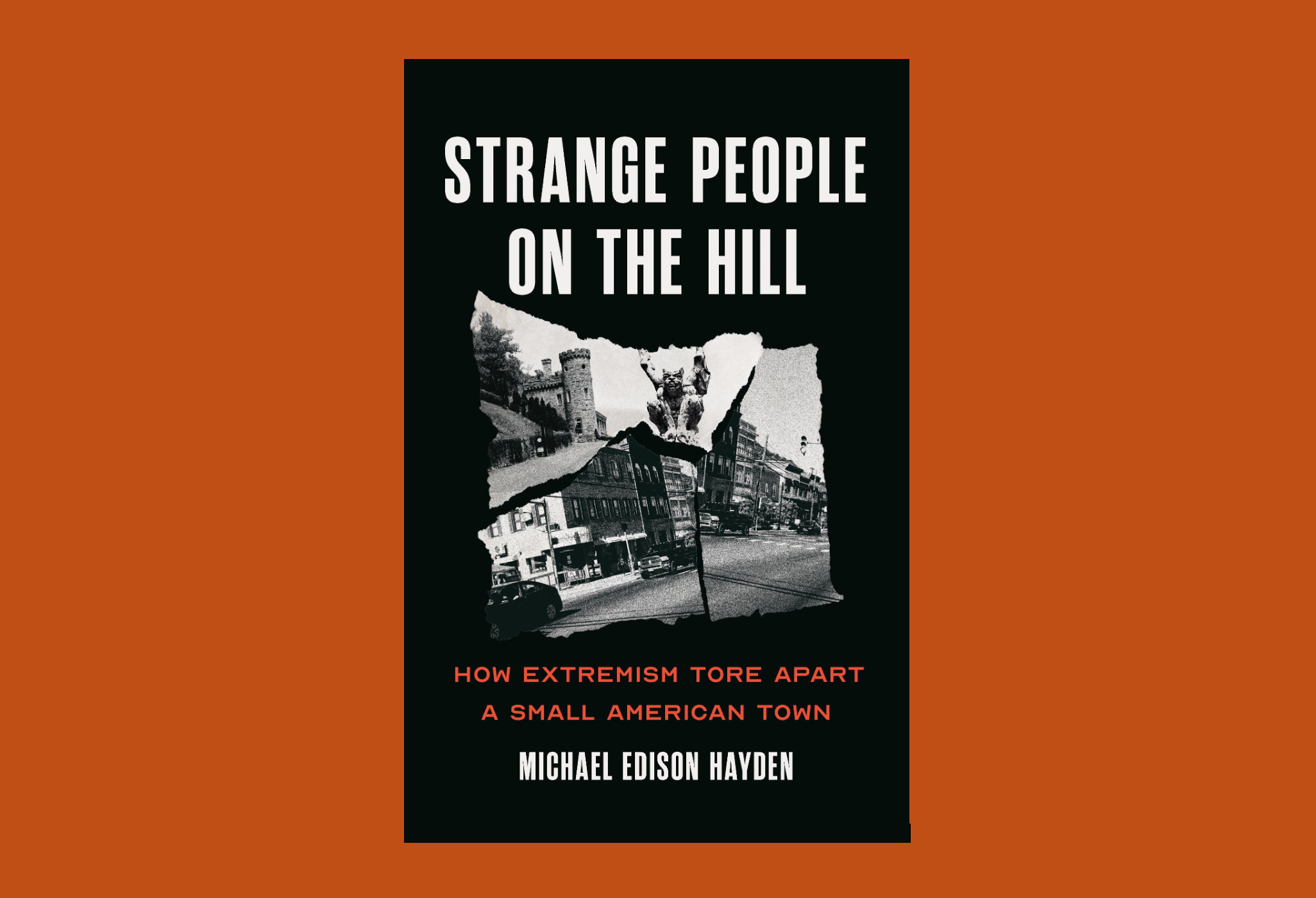
As I attempted to process the response that I found discouraging, if not completely unexpected, I was reminded of Michael Edison Hayden’s 2026 book, Strange People on the Hill: How Extremism Tore Apart a Small American Town.
Hayden is an accomplished investigative reporter, formerly employed with the Southern Poverty Law Center, who specializes in far-right extremism.
Strange People on the Hill, which is reminiscent of the quirky portrait of Savannah in Midnight in the Garden of Good and Evil, describes how the “somewhat queer-friendly” resort town of Berkeley Springs, West Virginia, was torn apart in 2020 by the arrival of the leaders of an SPLC-designated hate group.
As Hayden notes, that white-nationalist group, known as VDARE, was named not so subtly after Virginia Dare, “the first White child born into an English colony on the land that would become America.”
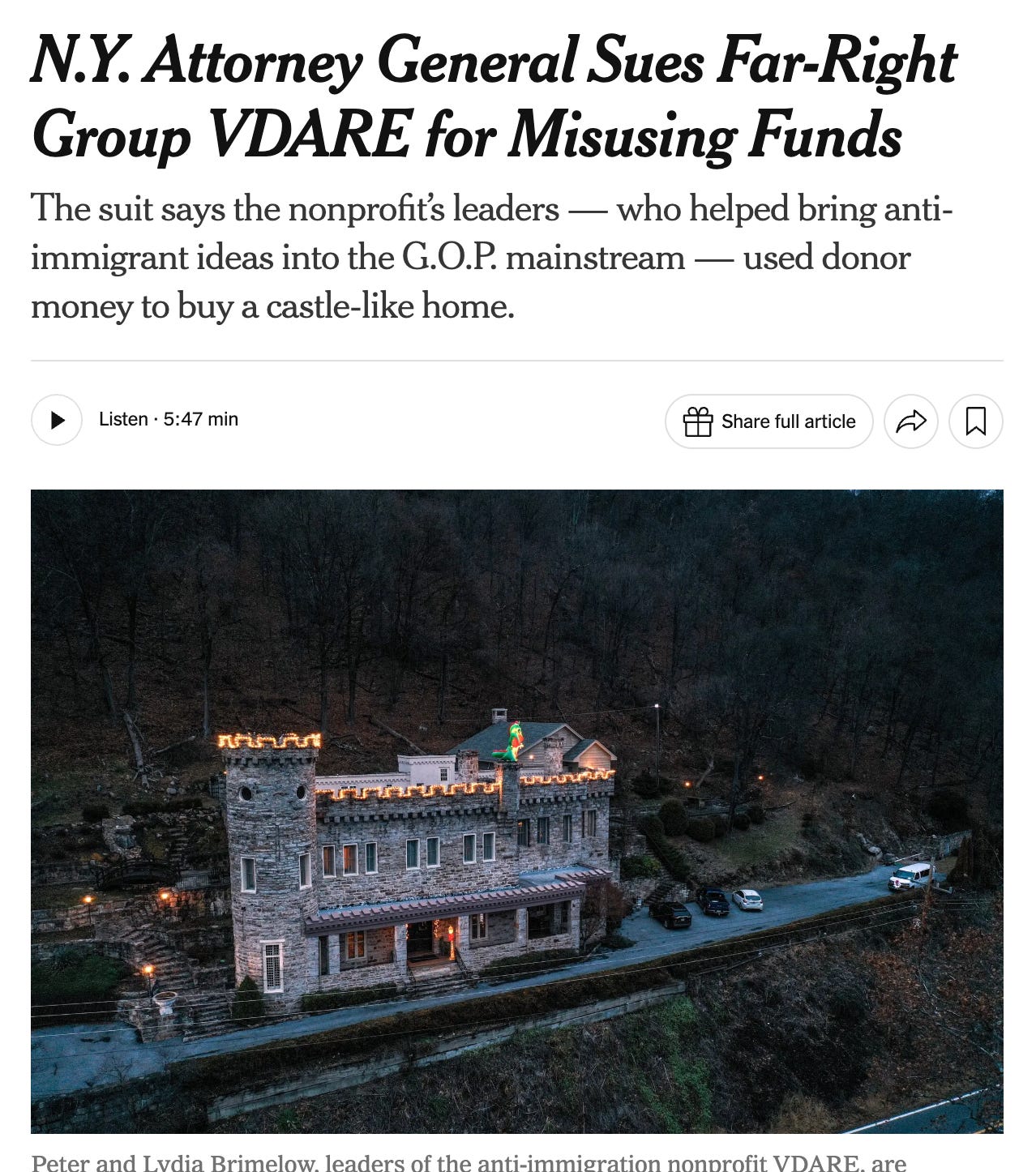
Its founder, Peter Brimelow, and wife Lydia had purchased a nineteenth-century sandstone castle that towered over Berkeley Springs.

Unlike other groups that had appeared on the SPLC hate lists, the Brimelows wrapped their extremism in the language of immigration reform.
“Peter Brimelow had played a critical role in turning the country into what it became under Donald Trump,” Hayden writes. “Not a Klansman from the era of lynching, but far from a typical conservative of the nineties and aughts, Peter effectively shifted Republicans away from neoconservatives and toward nativism. Eventually, that nativism would take America into a series of constitutional crises and to the edge of some American version of fascism.”
As news spread of the arrival of the Brimelows, more progressive voices in Berkeley Springs were alarmed.
Hayden notes that Peter Brimelow, while insisting that he decried violence, was completely ready to proclaim that acts of mass violence by right-wing terrorists should be addressed by ending the “great replacement.”
“It was never the movement—that group of people, including nativists, neo-Nazis, and white nationalists who performed activism in response to the great replacement—that was to blame,” Hayden writes. “It was always others.”
When neo-Nazi Mauricio Garcia “gunned down a random collection of innocent people who had exited a mall in Allen, Texas, at the wrong time, killing nine and wounding seven,” Hayden and his SPLC colleagues discovered that the killer had been a VDARE reader. Garcia had even posted one of VDARE’s anti-immigration screeds on a Russian social media site, Hayden writes.
Still, the Brimelows were welcomed into the local Catholic parish, as well as the community’s more conservative social circles.
Some defended Peter Brimelow as simply being “a journalist.”
“He writes about immigration,” one person told Hayden. “Some people may disagree with it. But he’s not a hate group like BLM and antifa. Or Pride.”
Hayden describes a meeting he held with community members who were concerned about what influence VDARE might have on the town they loved:
“In the electronic pages of VDARE they are repeatedly talking about a civil war,” I told the room. “And that we are in a cold civil war. Well, I am not in a civil war. I am not fighting a civil war. Okay? I’m not at war with anyone. No one here should be at war … with anyone.
“What I’d said might calm people’s anger at VDARE, but I realized after I said it that it was misleading. Just because I didn’t want to be in a civil war didn’t mean I could avoid it.”
‘You’ll outlast Peter Brimelow’
When Michael Edison Hayden first came to Berkeley Springs in 2020 in response to pleas for help for the community’s progressives, he assured those gathered for that first meeting that time was on their side.
“I’m obviously not a lawyer but I’m going to write about this situation, and I’m going to stay on it and use whatever platform they give me to help. I really believe in this town,” he recalls in Strange People on the Hill.
Hayden added, “You’ll outlast Peter Brimelow.”
In July 2024, Peter Brimelow announced the disbandment of VDARE.
“The conservative movement had started to emulate Peter at the same moment that conservatives abandoned him, leading to the termination of his nonprofit,” Hayden observes about the group’s demise.
And in September 2025, New York Attorney General Letitia James filed a lawsuit against the Brimelows “for years of self-dealing and abuse of charitable assets.”
As it turns out, Hayden had been right about the progressives outlasting the Brimelows—even if he at times may have harbored his own doubts.
As the journalist argues in the preface, it is those people who continued to have hope in the face of hate who are the real heroes—not the MAGA keyboard warriors who, in my case, are act as if they are ready to go to war over words they fail to recognized from our country’s Declaration of Independence.
“Trump has talked about serving the ‘forgotten men and women’ of America, his supporters,” Hayden notes.
“But are Trump’s ‘forgotten’ people truly forgotten, after two election wins and an authoritarian government pandering to their biases?”
Instead, Hayden sees the red-state progressives in Berkeley Springs as representing “a more neglected feature of American life.”
Here is how he describes his heroes:
“Outnumbered in their towns, people like the women I mentioned are spiritual optimists who dig deep to donate to nonprofit groups and Democrats, and then feel let down when the money gets squandered. They live among reactionaries and fight quixotic battles to make their neighborhoods more inclusive….
“When I feel down about what has happened to America, I try to remember that there are people like them in every town. You will find them waving hand-painted signs on the side of the road and meeting in coffee shops just like the one at the center of this book. They keep fighting, even after wealthy institutions surrender.”
Those people, Hayden adds, “are my ‘forgotten men and women’ and ‘the living’ for whom I wrote this book.”
Have you read Strange People on the Hill yet? (If not, it’s available in my online bookstore.) If so, what do you think?
Paid subscribers can discuss in the comments below.
I never knew this was going on. 😳 Of all of the pro-social, uplifting & life changing (in a positive way) things to spend money, time & energy on - these groups of people chose hate & alienation of others as their legacy / their "cause." I cannot wrap my mind around it. 🤷🏼♀️ 🥺 🤦🏼♀️ Phil, I hope someday, when this is over, you get a medal 🏅 of some sort for your fearless work & dedication to shine a light in & on the darkness. If that day never comes, for whatever reason, please know there are many of us who appreciate your work more than you will ever know. 🌟