

What I'm Reading - The Age of Insurrection: The Radical Right's Assault on American Democracy

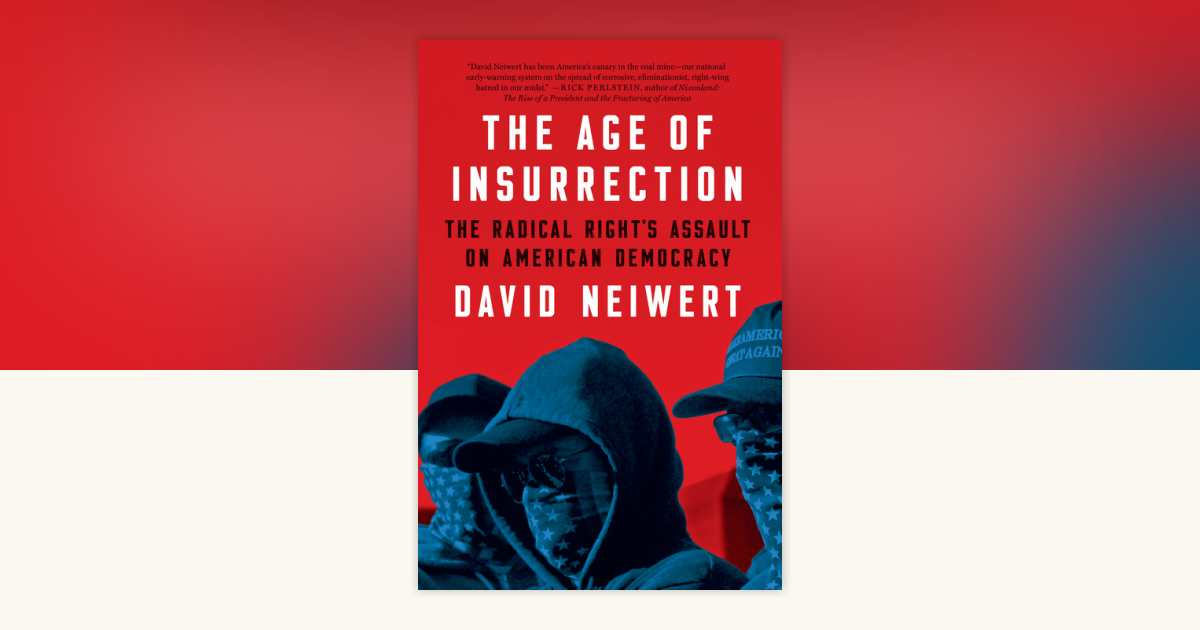
Two days before the January 6 riot at the U.S. Capitol, veteran journalist David Neiwert sounded the alarm.
“At the same time that Republican senators and congressmen say they will be contesting the certification of Joe Biden’s electoral victory in Congress, thousands of Trump supporters—ginned up on conspiracy theories and Trump’s groundless claims of election fraud, as well as his open invitation to supporters for what he promised will be a ‘wild’ event—will be taking to the streets to protest his defeat,” Neiwert wrote for the progressive Daily Kos website.
His warning was prescient: “Given the outcomes of previous pro-Trump protests in D.C., it is virtually certain to result in violence.”

Recently, I had a chance to dive into Neiwert’s brilliant 2023 book, The Age of Insurrection: The Radical Right’s Assault on American Democracy.
Neiwert, who began his journey by documenting the rise of right-wing extremism as a young reporter in the Pacific Northwest in the late 1970s, convincingly lays out a case that anti-democratic sentiments had been building within the far right well before the January 6 insurrection.
He writes:
“The siege of the Capitol had been carefully planned, orchestrated by paramilitary claques who spearheaded the attack, and supported by an army of true believers of various stripes: conspiracy theorists, Christian nationalists, and far-right street brawlers….”
“Preventing the certification of the Electoral College votes, however, was only the temporal objective of Trump’s army. In a larger sense, the insurrection’s intent was to overthrow democracy itself and replace it with an authoritarian autocracy.”
Throughout the well-crafted book, Neiwert makes it clear that those anti-democratic impulses are still being felt within American society, although many of those battles have shifted—at least, for now—to the local level.
For the Proud Boys, for example, it was a part of a deliberate strategy to focus on local issues in which they could involve themselves and recruit new followers. Unfortunately, Neiwert notes, it had the insidious effect of creating turmoil inside communities where little had previously existed.
The Age of Insurrection documents outbursts in towns across America—for example, the 2021 school board hearing in Williamson County, Tennessee, where anti-maskers threatened parents who had expressed support for a mask mandate—as evidence of the continued vitality of that insurrectionist streak.
And just as he warned of the dark day that ultimately was to be remembered simply as January 6, Neiwert cautions that the threat remains.
“They’ll only succeed, of course, if we keep our eyes closed to the continuing threat and fail to be prepared,” he concludes. “Because as far as they’re concerned, they are ‘at war.’ Only a fool would disbelieve them.”
Perhaps the reason that Neiwert’s book was so resonant with me is that, through his decades of experience, he confirmed what my own more limited experience has told me. Here is how I have laid out the thesis for Hate Comes to Main Street:
What I have come to realize is that the battle for the soul of America began on the main streets of America—as people with declining political influence desperately sought to retain their grip on the levers of society.
There, white supremacy, Christian nationalism, and QAnon conspiracy theories had begun as overlapping parts of the same Venn diagram, with one feeding upon the other until they were almost indistinguishable.
And each remains determined to maintain control over the nation’s politics—even if it means abandoning democracy.
And once hate had gained a foothold on Main Street, it was just a matter of time before it began to make its way to Pennsylvania Avenue.
In several chapters that I have already written for what I hope will one day become a Hate Comes to Main Street book, I have described characters from my own journey—Franklin, Tennessee’s Gabrielle Hanson, for example—as being the hero in the movies that played in their own heads.
Similarly, throughout The Age of Insurrection, Neiwert describes how the various factions of Trump’s army were shaped by their detachment from reality.
Describing one of those factions, he writes, “Two key things united the Patriots: first, the shared belief that a nefarious cabal of ultra-wealthy (and mostly Jewish) ‘globalists’ secretly control America’s political system, its government, and its media; and on January 6, they believed this cabal had conspired to manipulate the 2020 election to dethrone Trump and install a ‘Communist’ puppet in the person of Joe Biden.”
And here is how Neiwert explains the role of conspiracy in shaping such anti-democratic notions.
“Conspiracy theories offer narratives that explain why the country is no longer what they wish it to be. Simply put, it provides a clear self-reinforcing answer to the source of their personal disempowerment. It also has the advantage of telling believers that they are solo, go-it-alone action figures in the movies of their own lives.”
That is part of the very complex challenge we now face as a country.
The Age of Insurrection is a book that greatly helped me to understand my own journey, and it is completely deserving of my highest recommendation.
You can check out my Hate Comes to Main Street bookstore here. (Disclosure: I am an affiliate of Bookshop.org, and I will earn a commission if you click through and make a purchase—but the recommendations are absolutely sincere.)
What do you think?
What I Am Reading - To Catch a Fascist: The Fight to Expose the Radical Right

As my journey continues here on Hate Comes to Main Street, I will periodically share books or articles that I’m reading—or films that I find enlightening. I’d love to hear your recommendations, as well.
Searching for Christ in the Discussion of Christian Nationalism: A Tale of Two Books

For weeks, two books have sat side-by-side in my study at home.
Phil, I’ve decided to subscribe to you to support you in your efforts to speak to truth among us. Thanks for what you are doing.
My reading list just keeps growing.......