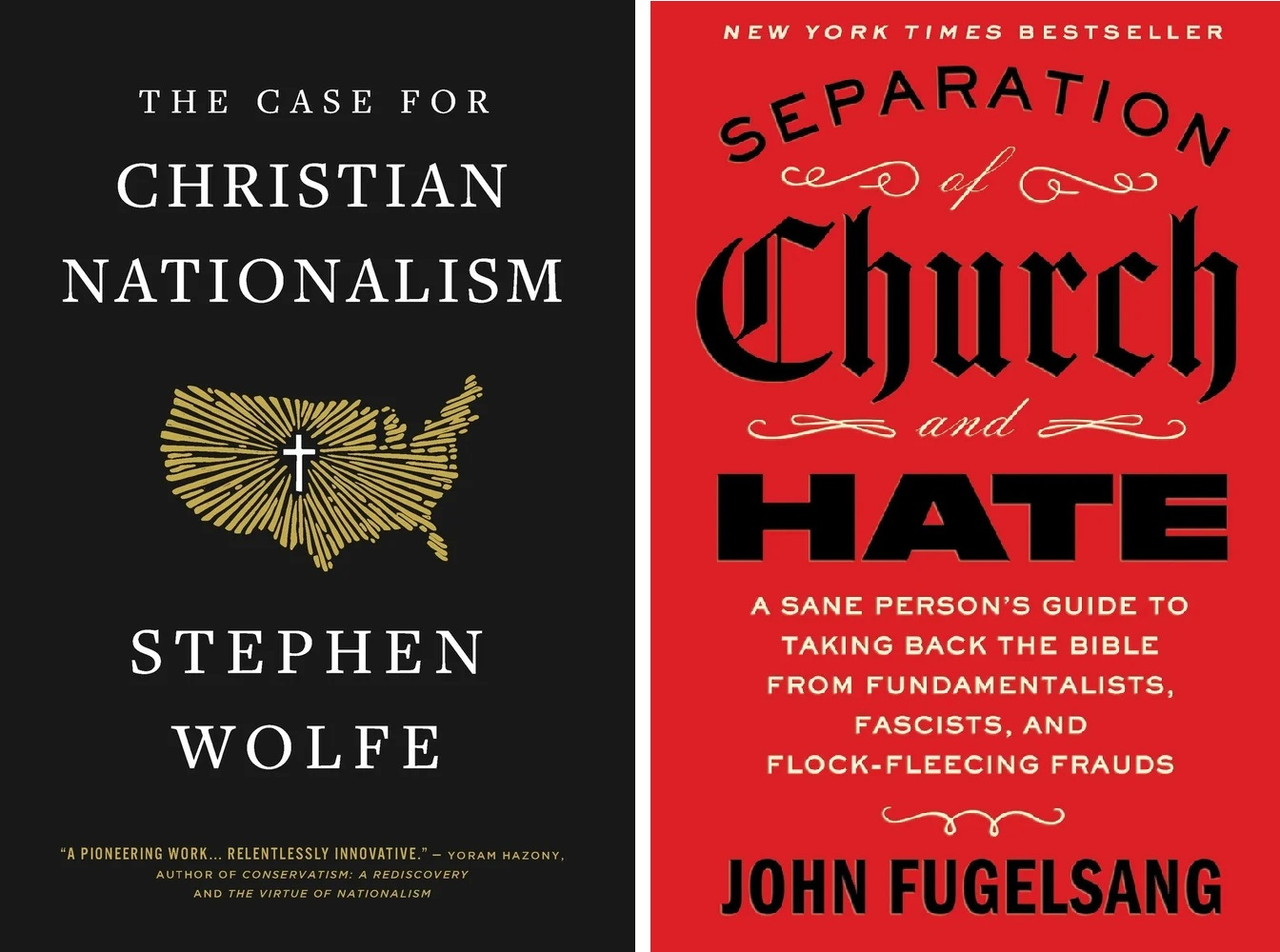
Searching for Christ in the Discussion of Christian Nationalism: A Tale of Two Books
One relies heavily on the words of Jesus, the other not at all. Guess which one!
For weeks, two books have sat side-by-side in my study at home.
How their close proximity failed to trigger spontaneous combustion remains a mystery.
The Case for Christian Nationalism by political theorist Stephen Wolfe is a ponderous work that reads like a Ph.D. dissertation. It has been described by its publisher as “a tour-de-force argument for the good of Christian nationalism, taken from Scripture and Christian thinkers ancient, medieval, and modern.”
As you will soon see, that description arguably takes more than a bit of literary license in its claim that Wolfe’s argument is “taken from Scripture.”
On the other hand, the New York Times bestselling Separation of Church and Hate by actor/comedian John Fugelsang is an entertaining read that offers, as the subtitle not-so-subtly suggests, “a sane person’s guide to taking back the Bible from fundamentalists, fascists, and flock-fleecing frauds.”
Give him credit: there’s no doubt about the perspective that Fugelsang brings to the conversation.
And do not let the authors’ titles—political theorist vs. actor-comedian—cause you to automatically assume whose arguments are the most well-reasoned.
A search of the Kindle versions of the two books indicates that Fugelsang’s Separation of Church and Hate uses the word “Jesus” a whopping 780 times in its 289 pages. When it does appear, Fugelsang is almost always quoting the figure from whom Christianity gets its name.
“Jesus,” on the other hand, is cited in Wolfe’s The Case for Christian Nationalism—get this!—just 20 times in its 497 pages.
If you’re keeping score on appearances by “Jesus” in the two books:
Separation of Church and Hate: 780
The Case for Christian Nationalism: 20
Searching for the word “Christ” is a bit more problematic because of its various derivatives—Christian, Christians, Christianity—but the index of Wolfe’s book indicates that “Christ” is the topic of just seven pages.
Fugelsang describes his approach this way:
“It’s a guide to everything the haters got wrong. It focuses on Christianity through the teachings of Jesus, known to some as the ‘red letters’ of the Bible. And it’ll show you that if you’re debating an authoritarian Christian on almost any subject that divides us, Jesus probably has your back.”
Wolfe, to his credit, is honest about his approach:
“Some readers will complain that I rarely appeal to Scripture to argue for my positions. I understand the frustration, but allow me to explain: I am neither a theologian nor a biblical scholar. I have no training in moving from scriptural interpretation to theological articulation.”
That’s right, The Case for Christian Nationalism does NOT rely upon Scripture to defend its position.
For example, Fugelsang cites the temptation of Jesus in the wilderness where Satan takes him to a high mountain and offers “all the kingdoms of the world and their splendor” if Jesus will bow down and worship the evil one.
Jesus, you will recall, rejected what has commonly been understood to be a temptation for political power.
“Christian nationalism,” Fugelsang argues, “is Jesus looking at the cross he has to carry, and then finally deciding, ‘Ya know what, Satan? I think I’ll take that deal.’”
Wolfe, on the other hand, never acknowledges that common argument against Christian nationalism.
Instead of relying on Scripture, Wolfe acknowledges that he draws mainly from Reformed Christian theology from the 1500s and 1600s, including ideas advanced by 16th century theologian John Calvin (who, it should be noted, died before the world came to accept that the Earth revolved around the Sun).
According to my Kindle search, the word “Calvin” appears 129 times in The Case for Christian Nationalism.
If you’re still keeping score:
Calvin: 129
Jesus: 20
On the rare occasion that Wolfe does cite something that Jesus actually said in the Gospels, he often turns to such quotes to argue that Jesus’ words—about turning the other cheek, for example—should not be taken literally.
He also dismisses any notion that Jesus’ insistence that his kingdom was “not of this world” should be taken as a repudiation of Christian nationalism.
But it may be Wolfe’s conclusions—conclusions inviting comparisons to Hitler’s Mein Kampf—that are most problematic.
Here is how those issues were summarized by pastor and theologian Kevin DeYoung in a review for The Gospel Coalition:
“The message—that ethnicities shouldn’t mix, that heretics can be killed, that violent revolution is already justified, and that what our nation needs is a charismatic Caesar-like leader to raise our consciousness and galvanize the will of the people—may bear resemblance to certain blood-and-soil nationalisms of the 19th and 20th centuries, but it’s not a nationalism that honors and represents the name of Christ.”
Where in the Bible does Jesus endorse a separation of the races, killing people who disagree with us on questions of faith, or lifting up dictators who will rule according to their interpretation of what it means to be a Christian?
John Fugelsang argues it is a debate worth having.
“Whether you’re a believer, agnostic, or atheist, whatever you think about politics, you’re going to have to deal with these people at some point. They want to control the level of freedom in US society based on how they pick and choose from the Bible.”
He tells his readers that there are two things for them to remember:
“Much of the time, these people don’t really know the Bible all that well. And they’re 100 percent counting on you not knowing the Bible all that well.”
What do you think?


I would like to see a real theologian take part in this debate. Pope Leo XIV has a lot to say about this subject.