

Checking the Facts on Salacious New SPLC Allegations
Did a former SPLC employee really 'funnel $1.2 million to lover in neo-Nazi group'? That's not what a new indictment actually says.


A review by Hate Comes to Main Street of salacious new allegations against the Southern Poverty Law Center has uncovered more questions about the strength of the Trump Justice Department’s case against the civil rights organization.
Those new allegations were contained in a recently returned superseding indictment of the SPLC on fraud and money laundering charges. This week, the New York Post trumpeted the development this way: “SPLC boss funneled $1.2 million to lover in neo-Nazi group — pair even had joint bank account.”
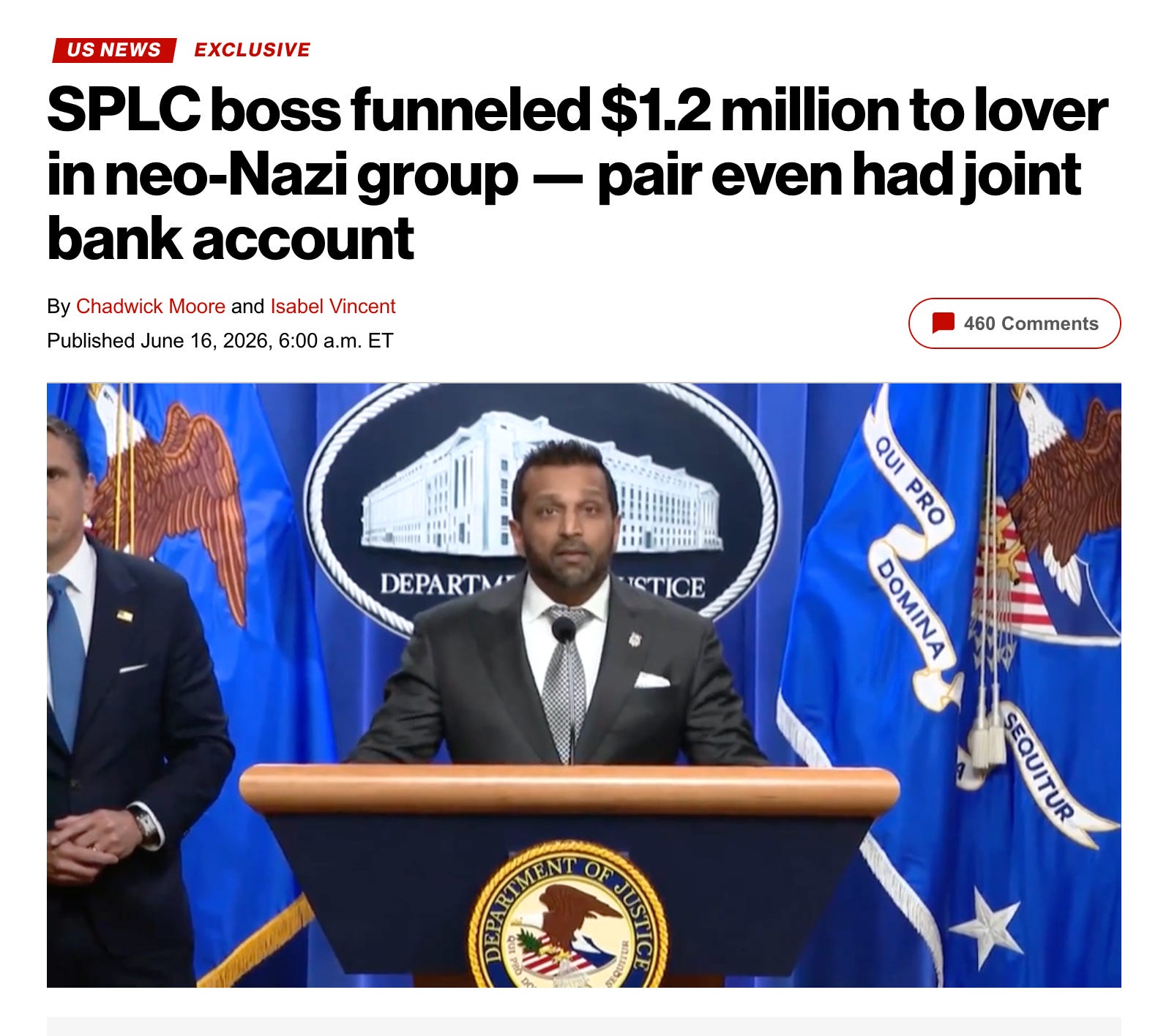
Those new charges came after the Trump administration’s original indictment of its longtime nemesis in April was widely ridiculed—even by white supremacists who had been SPLC targets—for its claims that the group had secretly staged Charlottesville’s deadly Unite the Right rally in 2017.
As I have reported, that spin runs counter to every known fact about what really happened in Charlottesville.
So, now, SPLC critics have latched onto the new allegations in the superseding indictment that a staff member—identified as “Employee-2”—was romantically involved with a paid informant who infiltrated the neo-Nazi National Alliance. That informant—a “field source”—is identified only as “F-9.”
While not being directly named, Employee-2 is described as someone “who would become Director of the SPLC’s Intelligence Project”—a high-ranking position but not the head of the organization as the term “boss” might imply.
Still, does the indictment really say that she “funneled $1.2 million” to a “lover” who was in a neo-Nazi group?
In a word: no.
What the indictment really says…
Just like the original indictment did not actually contain the allegations that Trump administration officials and SPLC critics claimed, a close reading of the new indictment reveals the evidence may also not be quite as the Post suggests.
A few key points:
SPLC paid that undercover informant $1.2 million between 2010 and 2023—a 14-year period—the indictment says.
That indictment, however, does not specify when Employee-2 allegedly began the relationship with the informant. So, it’s possible the relationship began well after much of that money had been paid.
The indictment claims, “Between 2015 and 2021, approximately $140,000 in donors’ money flowed from the SPLC operating account” and was deposited into a bank account that Employee-2 shared with F-9. That money was supposedly used “to pay the couple’s personal living expenses.”
However, the person identified by the Post as Employee-2 left SPLC in October 2019 amid a leadership shakeup at the organization, presumably meaning she no longer had control of payments to F-9 in 2020 and 2021.
So why would the DOJ’s indictment include payments to the informant after the woman was no longer an SPLC employee? And how much of that $140,000 was in that time period?
While raising potential ethical and legal issues about Employee-2’s conduct, that person has NOT been charged with any criminal wrongdoing. Southern Poverty Law Center Inc.—as a corporate entity—is the only defendant.
Yet, there are no allegations within the indictment that higher-ups within the non-profit organization itself knew about the potential conflict of interest nor that top SPLC brass directed it.
And there’s more…
At the heart of the Trump administration’s indictment—the alleged fraud—is the allegation that “SPLC hid from donors the fact that a portion of their donated funds was being secretly used to support extremist groups and to fund their violent, racist, and extremist activities.”
Yet, in the case of F-9, the superseding indictment alleges he broke into the headquarters of National Alliance in West Virginia, stealing “approximately 25 boxes of documents” that were used for an investigation published by SPLC.
That investigation—identified by the Post, correctly I believe, as one published in May 2015 under the headline “Chaos at the Compound”—was damning. It described “evidence of embezzlement, money laundering and more than two million dollars in unreported taxable income” within the neo-Nazi group.
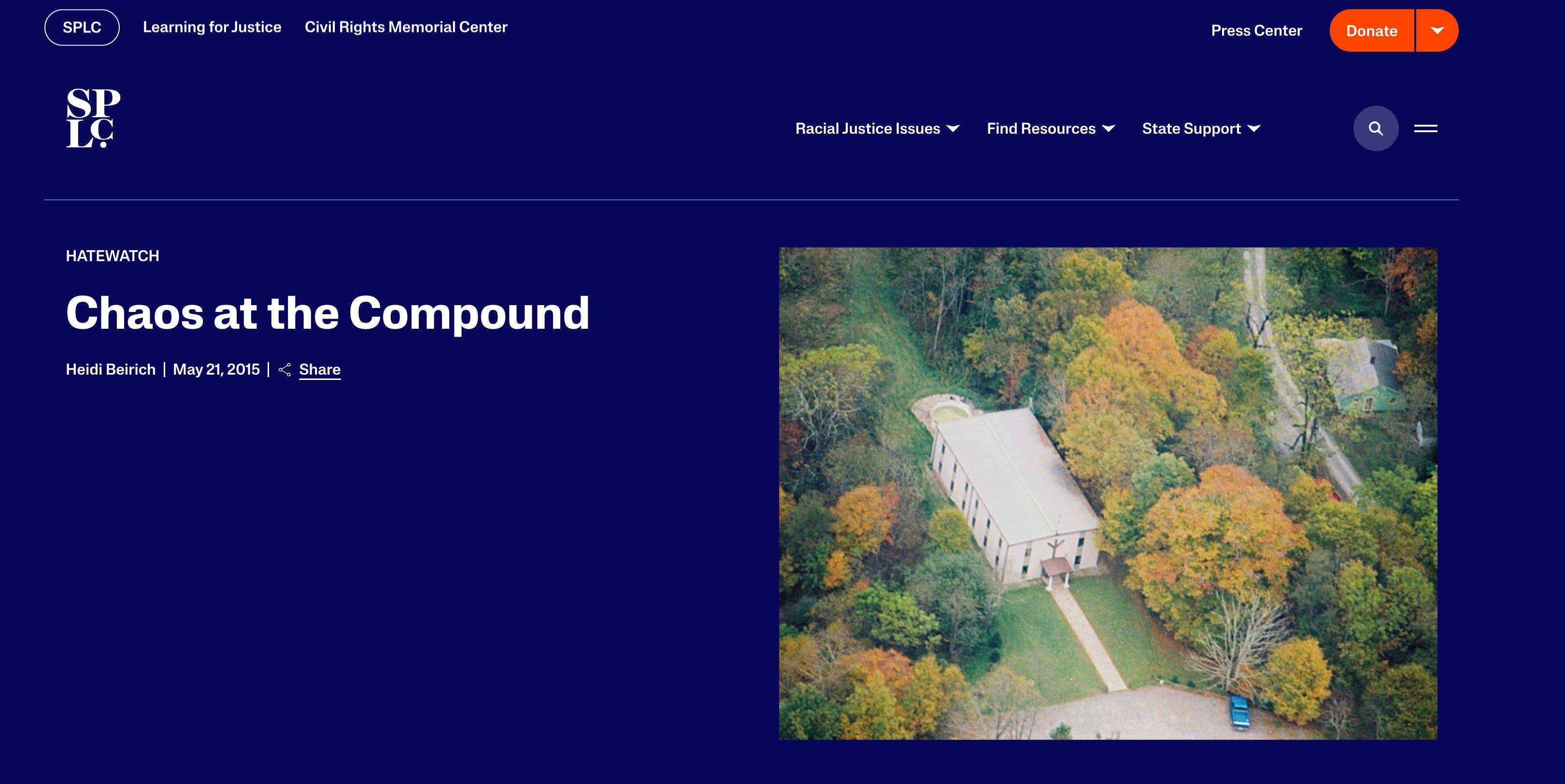
The report identified SPLC’s source as Randolph Dilloway, “an accountant … active in the neo-Nazi, white supremacist scene for more than a decade.” SPLC disclosed that Dilloway had been hired by National Alliance Chairman Will Williams to audit the group’s books, and he eventually turned on them.
Dilloway “was given full, unsupervised access to offices holding dozens of boxes of poorly-filed financial documents and data disks associated with the group’s various business entities going back to 1985,” SPLC’s reporting indicated.
The SPLC report continued:
“For five months, Dilloway organized, examined, and in many cases copied key documents and data files among tens of thousands of pages of sales receipts, donation records and ledgers. Dilloway claims that within the first 10 weeks he reported his audit findings to Will Williams and Alliance attorney, Timothy E. Kalamaros, and warned them the NA’s financial records showed a ‘prosecutable pattern of embezzlement and income tax fraud going back at least 15 years.’
“Among the thousands of pages of documents, database files, transaction records and digital media provided by Dilloway to the SPLC, the disturbing email exchanges he had with Kalamaros and Williams outlining possible financial improprieties earlier this year seem to suggest the Alliance attorney was advising them to ignore evidence of tax fraud and embezzlement to avoid being audited by the IRS.”
The SPLC report also said “Dilloway has since been interviewed by the FBI’s Joint Terrorism Task Force, and he is now seeking federal protection under IRS Whistleblower statutes.”
Still, according to the Post’s account—which seems to lean heavily on the word of current National Alliance leader Will Williams—Dilloway was likely just the stooge described in the indictment as someone who was paid $6,000 by Employee-2 to take the blame for stealing the boxes of documents.
Which also, presumably, meant throwing away his professional reputation as a trustworthy accountant—for $6,000.
Not a new line of attack
The Trump administration’s attack on the Southern Poverty Law Center regarding the National Alliance files follows the pattern of a federal lawsuit filed against the SPLC in 2018 by a former Baltimore city attorney who lost his job after being identified as a “neo-Nazi” based on Dilloway’s documents.
In 2018, Glen K. Allen filed a federal lawsuit against the person identified as Employee-2 by the New York Post and against the Southern Poverty Law Center accusing them of engaging in a criminal conspiracy.
“The Intelligence Project and SPLC paid Dilloway for the stolen documents,” Allen’s lawsuit claimed. “On information and belief, the amount paid for the stolen documents substantially exceeded $5,000.”
Allen’s lawsuit also claimed:
“On information and belief, the Intelligence Project and SPLC have paid not only Dilloway but other members, former members, friends, acquaintances, and spouses or former friends and spouses of members, and supporters or former supporters of the National Alliance for information about the National Alliance.
“On information and belief, the Intelligence Project and SPLC have also paid members, former members, friends, acquaintances, and spouses or former friends, acquaintances, and spouses of members, and supporters or former supporters of other ‘hate groups’ as defined by the SPLC for information.”
These allegations occurred during a time when the DOJ claims donors were being kept in the dark about their money being used to pay informants.
Like with the current criminal charges, that 2018 lawsuit accused the Southern Poverty Law Center of attempting to “masquerade as a 501c3 public interest law firm dedicated to a tax exempt educational mission, when in reality the SPLC fails the basic requirements for this favored status because of its illegal actions (including numerous instances of mail and wire fraud), multiple violations of canons of professional ethics (including improper disclosure of confidential and privileged documents and failure to train its nonlawyer employees)….”
Allen’s lawsuit was quickly dismissed by the trial court, a decision that was later upheld by an appeals court.
What do you think? Please let me know in the comments below.


