
Hate in a Hallmark Town, Part 3: My Life In the Eye of a White-Supremacist Storm
Once you see the threat posed by such groups to democracy, you no longer have the luxury of looking away. Thankfully, I now know there is an army of civic-minded people who have my back.
This post is part of a continuing series that explains how I began this unexpected journey into the world of hate. I hope you will find this publication to be part of an important conversation and will spread the word!
“We’ve got your back.”
That was the reassuring message that I quickly began receiving in the fall of 2023 as my reporting began to catch the attention of neo-Nazis and other white supremacists I was investigating because of their involvement in a mayoral election in affluent Franklin, Tennessee.
Being a relative newbie to the world of hate, I had no idea how many anti-fascist researchers were quietly embedded inside the social media of such groups in places like Telegram and Gab. Some of the researchers worked for well-funded civil rights groups like the Southern Poverty Law Center and the Anti-Defamation League; others simply did that work out of principle.
And those anti-fascist researchers operated under a moral code that required them to warn anyone who might be in danger.
“ADL’s Center on Extremism flagged the attached post from white supremacist Brad Lewis (owner of Lewis Country Store), which appeared on Telegram and includes a veiled threat ostensibly directed at you,” the first email read.
“You may already be aware of this, but I figured it was worth passing along in case you aren’t.”
SPLC senior researcher Jeff Tischauser passed along a similar concern.
Soon, I was being pinged on Signal by anonymous antifa activists—most whose names I still do not know today—who are always monitoring such chatter.
Brad Lewis was one of the neo-Nazis who appeared at a candidate forum in Franklin, supposedly to provide protection for MAGA candidate Gabrielle Hanson. Lewis and his buddies from the Tennessee Active Club had recently been the subject of an SPLC report about the fight club he hosted on the second floor of the convenience store he operated on the northwestern edge of Nashville.
Lewis, ironically, had threatened to kill me some 20 years earlier when his name popped up in a police corruption investigation.
“See ol Phil is a hair lip (sic) lying sack of shit for the international jew media,” Lewis wrote, adding a dig about my late wife who had died as a result of her losing battle with alcoholism and addiction. “He was snuggled uptight with all the Antifa journalists in Franklin city hall tonight.”
The post had been shared by Sean Kauffmann, the leader of the Tennessee Active Club who had also been present at the forum. Kauffmann was described by the Stop Antisemitism website as “a disturbed neo-Nazi and Holocaust denier with a documented history of violence and a massive cache of firearms.”
Lewis added, “I find it extremely amusing because they have no idea the ‘Day of the Rope’ is real… and it’s approaching quicker than they can prepare for it.”
That is a reference to the day predicted in the racist novel The Turner Diaries when journalists and other “race traitors” will be hanged.
“You better run… run… run…,” the post ended.
Over the coming weeks, I would get multiple alerts from such hate and anti-fascist researchers—for example, after a Moms for Liberty volunteer posted my photo that had been altered to appear as if I were wearing blackface. The post told a horrendously false story after me having once paid a Black janitor to start my car out of fear that there might have been a bomb planted inside.
Then came the Telegram post from an anonymous neo-Nazi account, Appalachian Archives, that seemed to have everyone freaked out. Even the FBI contacted Nashville police to alert them and to have them alert me.
First, Appalachian Archives began to make demands about what I should report, including insisting that there would be consequences if I did not post a video that their neo-Nazi allies had produced with Hanson’s campaign manager.
“This is our only Warning,” the account insisted. It concluded, “Always Watching, Always Listening, Always Near.”
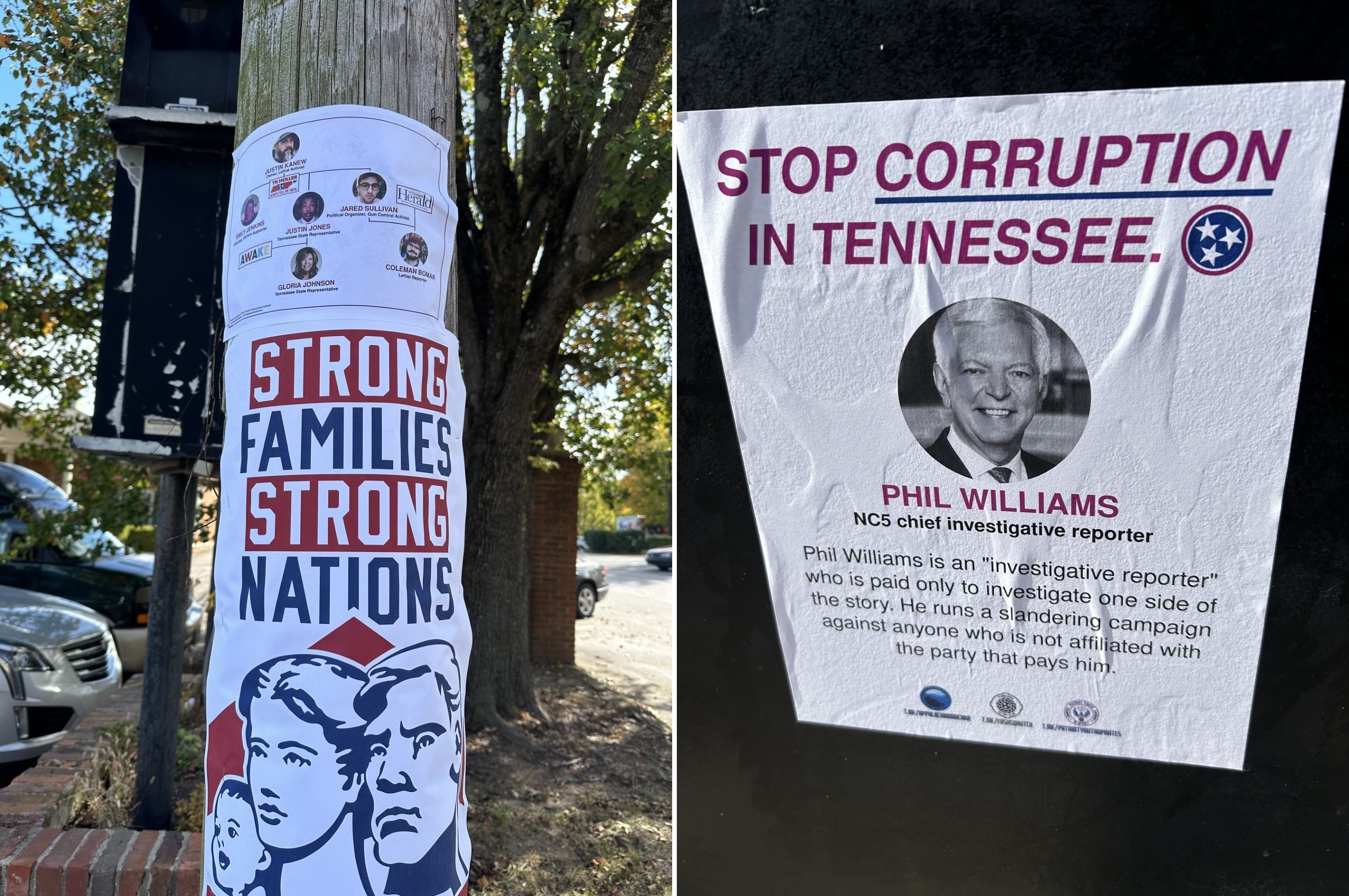
A few days later, my photo was posted on a utility pole in Franklin, along with Patriot Front propaganda and doxes of local activists, and Appalachian Archives posted images from my reporting about that incident.
“We are Watching You Phil, you Slander us, there Will be Repercussions,” it warned, again ending: “Always Watching, Always Listening, Always Near.”
Jeff Tischauser and I later talked about the threats from Appalachian Archives.
“My biggest concern at the time,” Tischauser said, “was that this account targeted you while also sharing manuals on how to make illegal weapon modifications, build bombs, choose targets, and stay off the grid.
“By targeting you, the account was trying to silence you through fear and censor your free speech.”
What we didn’t know at the time was, as Tischauser’s research would reveal, Appalachian Archives was being operated by active-duty U.S. soldier Kai Liam Nix. He was later busted by the FBI for selling illegal weapons.
“He tried to intimidate you while getting trained by the best Army in the world,” Tischauser said. “It could have been a lot worse.”
Such details invariably lead to questions about why I continue to do this type of work. That was a question I recently discussed with anti-extremism investigator Kristofer Goldsmith for his “On Offense” podcast.
As Kris put it, once you see the threat that such groups pose to democracy, you no longer have the luxury of looking away.
Thankfully, I now know there is an army of civic-minded people who have my back.
What do you think?


Woah.