
For A Time Such As This: The Difference One Person Can Make
Writer Cathy A. Lewis asks, "When your moment comes ... will you be the one who stands up—who speaks out—who chooses courage when it matters most?"

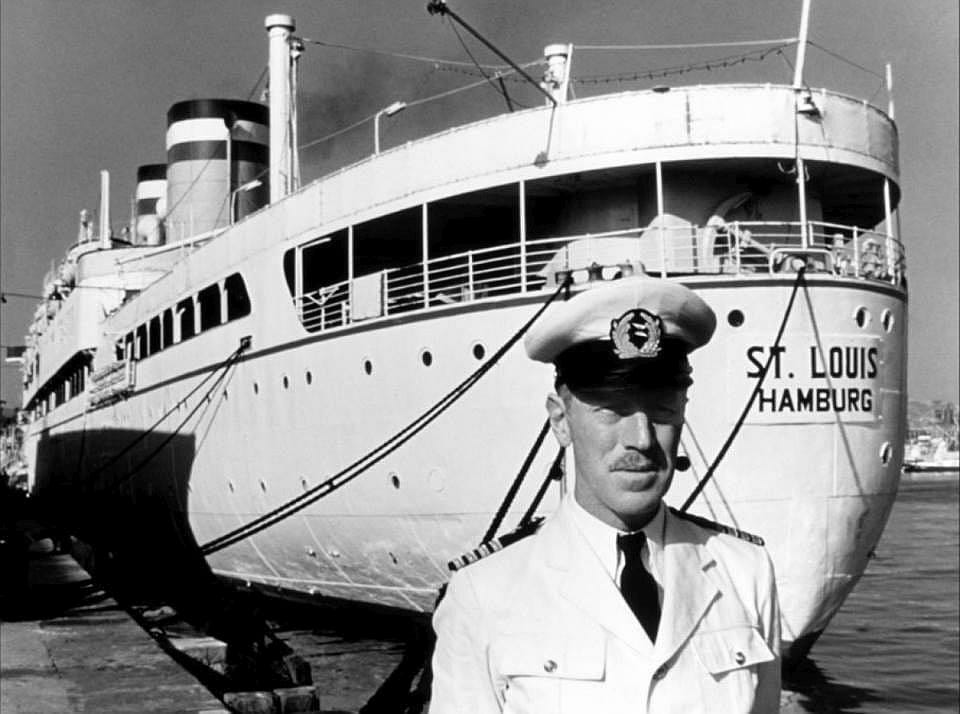
EDITOR’S NOTE: Recently, I had the honor of participating in Yom HaShoah, the 2026 Community Holocaust Commemoration hosted by the Jewish Federation of Greater Nashville. There, I heard Nashville chef and writer Cathy A. Lewis movingly speak about the journey of the transatlantic ocean liner SS St. Louis, the so-called “Voyage of the Damned.” With Ms. Lewis’s permission, I am sharing her remarks from that evening.

Imagine it’s June 1939. A ship carrying 907 Jewish refugees floats just miles off the coast of Florida—close enough to see the lights and palm trees of Miami, but with nowhere to land.
Mothers hold their children a little tighter as they stare out at the shoreline. Fathers stand silently, watching a country they had hoped would save them drift just out of reach. Children—too young to understand—simply wonder why they cannot go ashore.
These passengers were fleeing Nazi Germany, where their lives had already been dismantled piece by piece. After Kristallnacht, Jewish businesses were destroyed, synagogues burned, and thousands were arrested. It was not just violence—it was a warning.
The Nuremberg Laws had already stripped Jewish citizens of their rights. They could no longer vote. They could no longer hold many jobs. They were excluded, isolated, and humiliated. Doctors could no longer treat patients. Lawyers could no longer practice law. Teachers could no longer teach.
Imagine waking up one day and being told that everything you worked for—your career, your identity, your place in society—no longer belongs to you.
And worse—your neighbors, your government, even your country—now see you as less than human.
Families who had lived in Germany for generations were suddenly strangers in their own homeland.
So they fled.
They sold what little they had left. They packed what they could carry. And they boarded a ship with one hope: safety.
The year before, at the Evian Conference in France, thirty-two nations met to address this growing crisis. They’d heard the threats made by Hitler and the Third Reich towards the German Jewish population and the Jews of Eastern Europe. Nation after nation expressed sympathy—but none were willing to open their doors in any meaningful way.
The world knew what was coming.
And the world hesitated.
Nazi leaders were watching closely, monitoring the Evian Conference. Every closed door, every refusal, sent a message: no one is coming to help.
Then came one final test—the voyage of the SS St. Louis leaving Hamburg May 13th, 1939, bound for Havana, Cuba.
But when it arrived, the passengers were denied entry. Their landing permits were suddenly invalid.
Negotiations failed.
Hope began to slip away.
![Refugees aboard the "St. Louis" wait to hear whether Cuba will grant them entry. [LCID: 44112] Refugees aboard the "St. Louis" wait to hear whether Cuba will grant them entry. [LCID: 44112]](https://substackcdn.com/image/fetch/$s_!rO4Q!,w_1456,c_limit,f_auto,q_auto:good,fl_progressive:steep/https%3A%2F%2Fsubstack-post-media.s3.amazonaws.com%2Fpublic%2Fimages%2F0fa76e5e-7610-47e7-bccd-2e6a9cea0b7d_1024x717.jpeg)
With nowhere else to go, after being at sea for two weeks, the ship turned toward the United States.
And for a moment—just a glimmer of a moment—hope returned.
On board were many professionals—doctors, teachers, engineers—people who could contribute to society. Families who wanted nothing more than a chance to rebuild their lives. And the 200 children who simply needed a place to grow up, to be free, to play, learn, in safety.
The United States had a choice. A seminal moment.
Would it rise to the opportunity?
Would it act not out of fear, but out of compassion?
Would it lead?
Or would it turn away?
The decision rested with one man: Franklin D. Roosevelt. The most powerful man in the world.
Messages poured in. Appeals were made. Humanitarian organizations begged for action. Telegrams from parents with pleas to at least “give refuge to the children” aboard. These pitiful cries reached Eleanor Roosevelt, a woman known for her advocacy for children, a said “champion of children.”
But still—no answer came.
No exception was made.
No door was opened.
And the answer—from the most powerful nation in the world—was no.
The ship was forced to turn away. Coast Guard Cutters were sent with a message from the President of The United States. “SS St. Louis, leave US waters now.” The message was blared through a megaphone, while shots were fired, underscoring the communication.
Imagine the silence on that ship as it began to move away from the American shore. Imagine the realization settling in—that the last hope had just disappeared behind them.
Nine hundred and seven people.
Now with nowhere left to turn.
In that moment, the fate of these individuals—and perhaps the moral example set for the world—hung in the balance.
Could saying yes to the ship change the course of history, the greatest power in the world granting refuge to 907 German Jews, would that have mitigated the Reich’s plans to annihilate the Jews of Europe?
World War 2 started a mere 11 weeks later.
We will never know the answer to the lack of decisive action.
But then, one man made a decision.
The ship’s captain: Gustav Schröder.
He was not a politician.
He was not a world leader.
He did not command armies or shape global policy.
But he had something just as powerful: a conscience.
Though he served within Nazi Germany’s system, he did not share the hatred driving it. While others followed orders without question, Schröder chose a different path.
He chose humanity.
He treated his passengers with dignity. He refused to label them as less than human. He saw them for what they were—families, individuals, people in desperate need of help.
When orders came to return the ship to Germany, he defied those orders.

He knew what awaited his passengers. Certain death.
By this point, the threat was no longer abstract. It was real. It was imminent.
In fact, a large contingent of passengers approached the ship’s Captain with a chilling message: if the ship returned to Germany, they would rather die at sea than face what was waiting for them.
Think about that.
A group of people so desperate… so terrified… that they would choose suicide in unknown chilling depths of the Atlantic, embraced by the icy fingers of the sea over the certainty of death at the hands of those that hated them.
And Schröder listened.
He took their fear seriously. He carried their burden.
He even considered an extraordinary act—running the ship aground near the coast of England. Not out of recklessness, but out of strategy. He believed that if the ship were wrecked, international law—and basic human decency—would force a rescue.
He was willing to risk his career.
His reputation.
Even his life and the lives of his wife and two children. His family, lived in Berlin, a stone’s throw from the Reichstag.
Schröder was willing to risk everything for people he had just met weeks prior.
Why?
Because it was the right thing to do.
Eventually, through the efforts of Morris Tropper and the American Jewish Joint Distribution Committee, a solution was found. The passengers were allowed to disembark in Antwerp—split among England, France, Belgium, and the Netherlands.
![The "St. Louis," carrying German Jewish refugees denied entry into Cuba and the United States, arrives in Antwerp. [LCID: 69259] The "St. Louis," carrying German Jewish refugees denied entry into Cuba and the United States, arrives in Antwerp. [LCID: 69259]](https://substackcdn.com/image/fetch/$s_!ataQ!,w_1456,c_limit,f_auto,q_auto:good,fl_progressive:steep/https%3A%2F%2Fsubstack-post-media.s3.amazonaws.com%2Fpublic%2Fimages%2F804dae22-8aa9-4706-97eb-a8f55f9826e8_1024x755.jpeg)
It was not ideal.
But it was something.
And for many, it meant survival.
But history reminds us that the danger had not passed.
As World War II unfolded, Nazi forces swept across Europe. France, Belgium, and the Netherlands fell under occupation.
Of the 907 passengers, 254 would later be murdered in the Holocaust, many at Auschwitz concentration camp.
Two hundred and fifty-four lives lost.
But six hundred and fifty-three survived.
Six hundred and fifty-three people were given more time—more life—more chances to see their families, to build futures, to exist.
Because one man chose to act.
Not a government.
Not a conference of nations.
Not a powerful institution.
One person.
Years later, on March 11, 1993, Gustav Schröder was honored posthumously by Yad Vashem as a person Righteous Among the Nations.
A title reserved for those who risked everything to stand against injustice.
Not because it was easy.
Not because it was expected.
But because it was right.
And that brings us here.
To this moment.
Because history is not just something we study.
It is something we learn from.

The question is not what you would have done in 1939.
The real question is—what will you do when your moment comes?
Because it will come.
It may not look like a ship off the coast of Florida.
It may not be broadcast to the world.
It may be quieter.
Smaller.
Easier to ignore.
A moment where you see something wrong—and have the choice to speak up or stay silent.
To step in or walk away.
To help—or to do nothing.
And in that moment, you may think: “I’m just one person. What difference can I make?”
But history has already answered that question.
One person can make the difference between silence and action.
Between fear and courage.
Between life and death.
So I ask you: When your moment comes, will you look away? Or will you be the one who says yes? Will you be the one who stands up—who speaks out—
who chooses courage when it matters most?
“Never Again” requires action, not just remembrance.
Be that one person.
Cathy A. Lewis is the author of Some Came by Ship, based on the true story of the SS St. Louis. Her previous book, The Road We Took, is the harrowing account of an American Boy Scout in Nazi Germany.


